

Watching the Sky in Ancient Egypt
Long before anyone owned a telescope, Egypt kept time by the sky. The year began when a star rose; temples were set down along lines the sun would honour twice a year; and the hours of the night were counted by watching one constellation hand the horizon to the next.
Sail the Nile today and you pass through the remains of that attention. This is a short history of it.
The star that started the year
The Egyptian new year began not with a date but with an observation: the first dawn on which Sirius, the sky's brightest star, rose just ahead of the sun after weeks of absence. The Egyptians called her Sopdet, and her return was the great annunciation, arriving each year alongside the Nile's life-giving flood.
From that single reliable star, Egypt built a calendar of twelve thirty-day months and five added days at the year's end: 365 days, millennia before Rome borrowed the idea. The civil year of the pharaohs is a direct ancestor of the one on your wall.
The hours belonged to the stars
Egyptian astronomers divided the night using the decans, thirty-six star groups whose risings marked the hours in turn. Priests tracked them with a sighting instrument called a merkhet, a plumb line and straightedge that let two observers fix a star's crossing of the meridian. Tomb ceilings, most famously that of the architect Senenmut, carry star charts precise enough that scholars still study them.
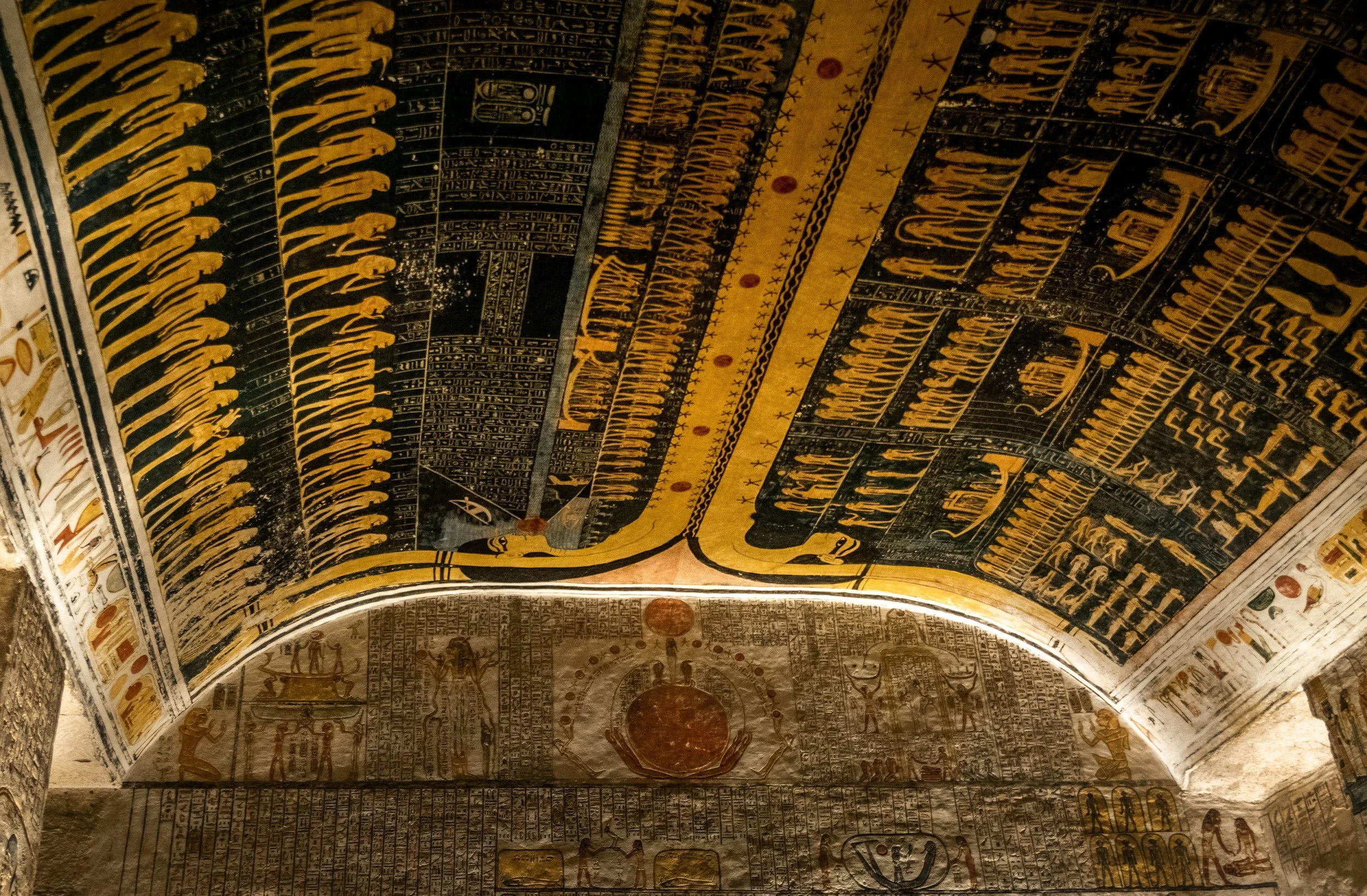
Astronomical scene on ancient Egyptian tomb ceiling
Architecture that faces the sun
The great temples are aligned. Karnak's main axis is set so that at the winter solstice the rising sun drives its light straight down the avenue of the hypostyle hall, through 134 columns built to receive it. At Abu Simbel, twice a year, the dawn reaches sixty metres into the mountain to touch the statues in the sanctuary. These are not accidents of beauty. They are astronomy, executed in sandstone.
The Dendera zodiac
On the ceiling of a chapel at Dendera, north of Luxor, the whole sky was carved in one circular map: constellations, planets, and the round of the year, held up at its rim by goddesses and spirits. The original stone was taken to Paris two centuries ago and a faithful replica now stands in its place, but the room itself is unchanged, and standing beneath it remains one of the quiet astonishments of the Nile.
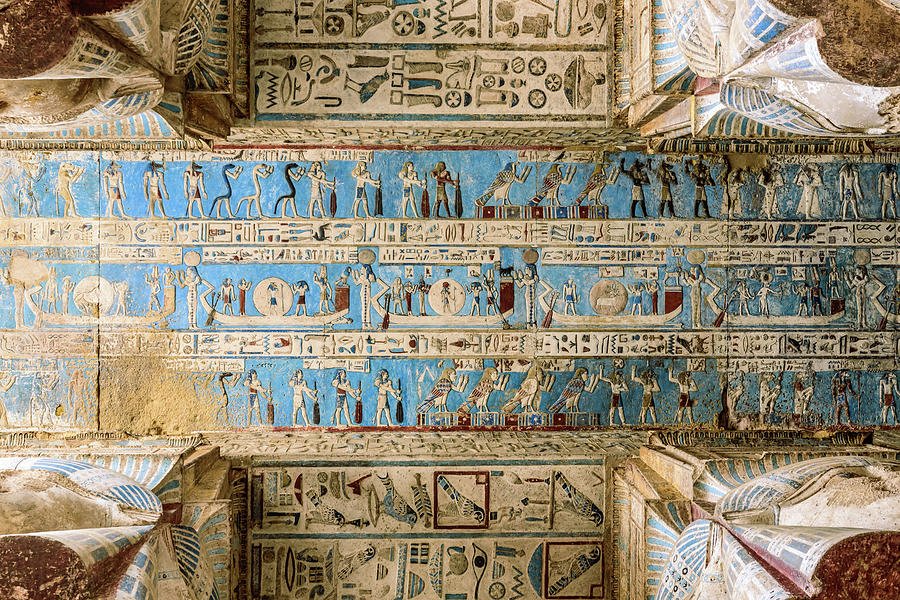
Restored ceiling of Hathor temple, Dendera temple complex
And eclipses?
Here the record turns curiously quiet. A civilisation that logged the stars for three thousand years left almost no unambiguous account of a total solar eclipse, and scholars still argue over whether certain myths, the sky-goddess Nut swallowing the sun among them, carry its memory. Perhaps the event was too fearsome to write down. Perhaps the texts are simply lost.
Either way, there is a certain symmetry ahead. On 2 August 2027, the longest totality this century crosses Upper Egypt at midday, directly over the landscape that watched the sky more carefully than anywhere on Earth. We will be on the river beneath it, aboard a dahabiya holding open water near Luxor. If you are curious what the day itself involves, we have written about that too.
Egypt, with reverence.