

Your First Total Solar Eclipse: What to Expect
People who chase eclipses across the world agree on one thing: nothing quite prepares you for the first one. Photographs do not carry it. Descriptions run out of adjectives and start again. But knowing the shape of the event, what happens and in what order, lets you spend those minutes watching instead of wondering.
So here is the shape of it, minute by minute, written for anyone whose first totality is still ahead of them. Ours is on 2 August 2027, over the Nile.
The long approach: the partial phase
Totality does not arrive suddenly. For well over an hour beforehand, the Moon takes the Sun a little at a time, and for all of that hour the rule is absolute: you look only through certified solar-viewing glasses. Ordinary sunglasses will not do, and the Sun gives no warning before it damages an eye.
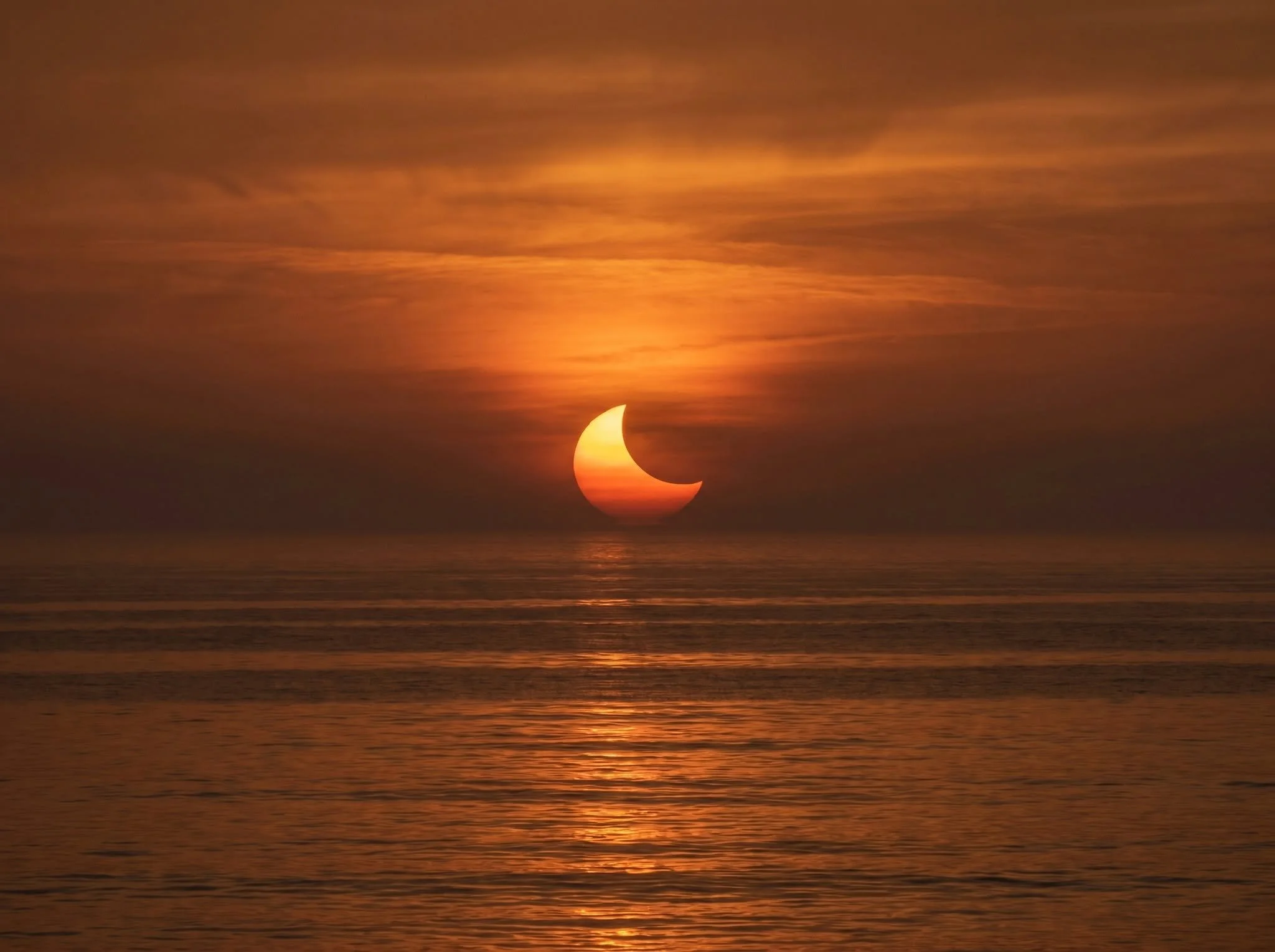
For most of the partial phase, honestly, the world looks normal. Then, in the last quarter hour, things begin to slide. The light turns thin and silvery, as though the day were being described rather than lived. Shadows sharpen strangely. The temperature eases. Birds start to make their evening arrangements at midday.
The last minute
The final seconds have their own vocabulary, earned. The last bead of sunlight blazes on the Moon's edge like a ring with one diamond. Then it is gone.
Totality
The glasses come off. This is the part no one is ready for: a black disc where the Sun was, ringed by the corona, the Sun's outer atmosphere, pale and enormous and utterly still. Venus and Mercury stand in a darkened noon sky. The horizon glows with sunset colours in every direction at once, because thirty kilometres away in each direction, the eclipse is not total.
In 2027, this lasts up to six minutes and twenty-three seconds near Luxor, the longest totality over land between 1991 and 2114. Six minutes sounds brief. Inside it, time behaves differently.
Advice from those who have stood in the shadow
Every experienced eclipse-watcher gives first-timers the same counsel: do not spend your first totality behind a camera. The photographs already exist, taken by people with better equipment than you will bring. The experience does not. Decide beforehand to simply stand in it, and let the professionals do the documenting.
The other advice is about place. You want an open horizon, no chance of a stray cloud, and ideally some stillness around you, because totality is quiet in a way a crowded viewing site is not.
Which is why we chose a boat
On 2 August 2027 we will be aboard a dahabiya, a traditional two-masted sailing boat, holding open water near Luxor at the point of greatest eclipse. Twenty guests, an Egyptologist, an unobstructed sky in every direction, and certified glasses provided for the partial phases. The river gives the one thing land cannot on eclipse day: room, and silence to hear the birds change their minds.
The journey around it, five nights from Luxor to Aswan, is here. And if you are still weighing countries, we have compared the whole path honestly: Where to Watch the 2027 Total Solar Eclipse.
Egypt, with reverence.